What I Spoke About at QonfX: Next-Level QA in the Age of AI
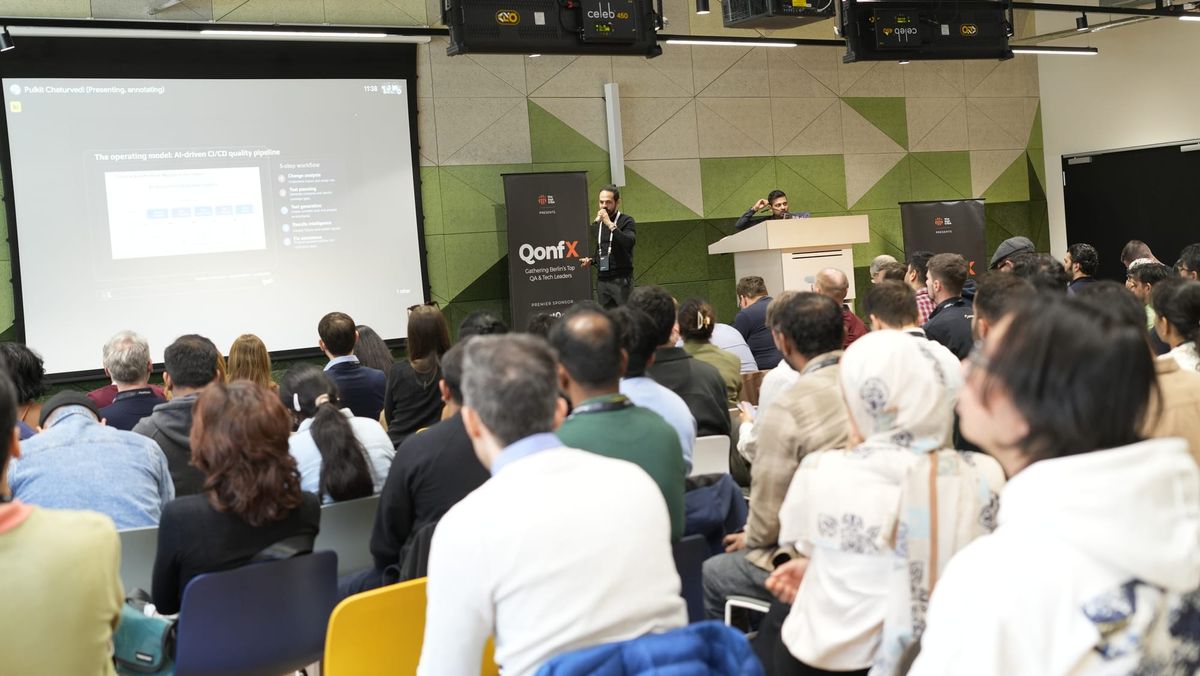
Recently, I had the opportunity to speak at the Test Tribe QonfX about a topic that has been occupying my mind deeply: what QA must become in the age of AI.
I was fascinated to see most of the professionals attending the conference where searching for the same answer. I know, because my talk started by asking the audience that question. I heard crickets and saw confused faces. Then, I started:
AI is not the end of QA. It is an opportunity to elevate QA.
For years, many teams have confined QA to a narrow space at the end of the software lifecycle. QA is often brought in after requirements are discussed, design decisions are made, and implementation is already underway. In that model, the role becomes associated mainly with test execution, bug reporting, and release validation. But that model is becoming increasingly insufficient.
As AI continues to accelerate software delivery, repetitive and execution-heavy work will be reduced, automated, or assisted more aggressively than ever before. This creates understandable anxiety in the QA field. Many professionals are asking: If AI can generate test cases, create automation, analyze logs, and even propose fixes, then where does QA still fit?
My answer is this: QA still fits where it always should have been heading — at a more strategic level.
In the talk, I framed this evolution through what I call the 3 Pillars of Next-Level QA.
1. Rise from marginal to impactful
The first pillar is about refusing the passive version of QA.
Too often, QA is treated as a downstream function, invited only when it is time to “test.” That setup naturally limits influence and weakens confidence. It also leads many QA professionals to feel disconnected from the real decisions that shape product quality.
Next-level QA requires something different: QA must seek involvement earlier. That means being present in requirement discussions, design conversations, planning, and architecture reviews. Quality problems are often born long before a build reaches a test environment. If QA wants to have real impact, it must help shape the system before defects materialize.
2. Practice QA as a thinking discipline
The second pillar is about reclaiming the intellectual identity of QA.
One of the most damaging misunderstandings about QA is the idea that testing is simply “clicking around” to see if something breaks. That view trivializes the profession and hides the actual mental work behind good QA.
Strong QA is not mechanical. It is analytical. It requires structured thought, risk anticipation, scenario design, investigation, reasoning, and systems awareness. A good QA engineer does not stop at validating the obvious path. They ask deeper questions. They explore edge cases, integration risks, failure conditions, and real-world complexity.
This is one of the most important messages I wanted to communicate in the talk: QA is a discipline of thinking, not just execution.
3. Rebuild respect for QA practice
The third pillar is about visibility and measurable impact.
A major problem in our industry is that QA often contributes real value without being able to express it clearly in business terms. If impact is not visible, it is easy for leadership to undervalue it. If it is not measured, it becomes vulnerable to misunderstanding.
That is why QA must become more deliberate about defining success criteria, tracking meaningful KPIs, and communicating outcomes in the language that organizations understand. Respect for QA does not come from asking for appreciation. It comes from showing evidence of value.
Where AI fits into this
After establishing the three pillars, I moved in the talk to the AI part of the story.
My position is not that AI replaces QA thinking. It is that AI can help operationalize higher-level QA more effectively.
I shared a vision for an AI-driven CI/CD quality pipeline built around five steps:
- Change analysis
- Test planning
- Test generation
- Results intelligence
- Fix assistance
This model treats QA not as a final gate, but as a continuous intelligence layer across delivery. Instead of waiting until the end to run tests, the system begins by understanding what changed, assessing risk, deciding what needs validation, generating or selecting the right checks, interpreting failures intelligently, and even assisting remediation under human review.
The key principles here matter just as much as the mechanics: high signal over high volume, explainability by default, human-in-the-loop governance, and measurable outcomes.
In other words, the future is not just “more AI tools for testers.”
The future is a broader quality intelligence system.
My closing message
The deeper message of the talk was this:
The future of QA is not about clinging to older forms of execution work.
It is about stepping into a stronger identity.
QA must become more vocal, more thoughtful, more measurable, and more system-oriented. AI should amplify that evolution, not define it for us.
So when I think about the QA professional of the future, I do not think first of someone who runs more tests.
I think of someone who can:
- influence quality earlier,
- think rigorously about risk,
- translate quality into decision-making,
- and use AI as leverage without surrendering judgment.
That, to me, is next-level QA.